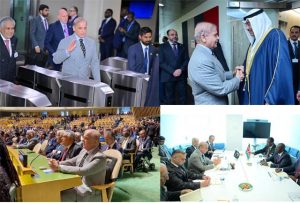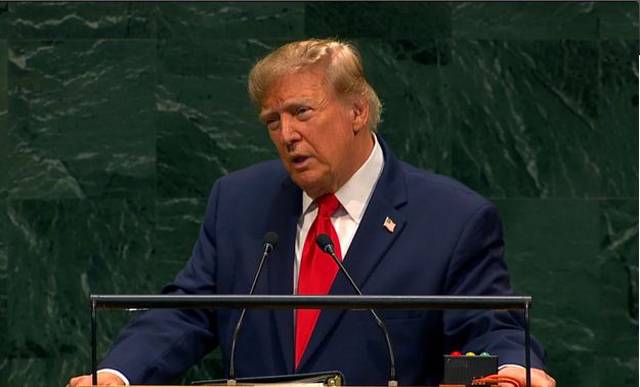
UNITED NATIONS – United States President Donald Trump on Tuesday praised Prime Minister Shehbaz Sharif, calling him a “terrific man” while highlighting his direct intervention in brokering a ceasefire between Pakistan and India in May last year, saving 30 million lives.
Trump, in his address at the opening session of the 81st United Nations General Assembly, reflected on his foreign policy achievements over the past year, placing special emphasis on his mediation between Islamabad and New Delhi.
He revealed that Prime Minister Shehbaz Sharif personally acknowledged his decisive role, stating that the US President was directly responsible for saving over 30 million lives.
He told the gathering of world leaders, including Prime Minister Shehbaz Sharif – who landed in New York on Monday to attend the event – that after assuming the office, he had a great honor to settle eight wars many of which had gone on for many years and even decades. Trump said that he had been able to make these settlements by using his “very, very special” relationships.
He said that among the wars he had settled included Cambodia and Thailand, Kosovo and Serbia, the Democratic Republic of the Congo and Rwanda, Pakistan and India, Armenia and Azerbaijan, and, of course, the war in Gaza, which included the return of all hostages, both living and dead. “Almost every one of these countries wrote me a letter of thank you. The Prime Minister of Pakistan – terrific man – said that Donald Trump was responsible for saving 30 million lives and probably many more than that,” he commented.
This was not the first time President Trump has publicly praised Prime Minister Shehbaz Sharif as he had previously commended Prime Minister Shehbaz and Field Marshal Syed Asim Munir, calling them “two fantastic people.”
At the inaugural meeting of Board of Peace, he praised PM Shehbaz’s leadership while recalling Pakistan’s role in halting regional escalations with India.
On different occasions, he has also praised Field Marshal Asim Munir, calling him a “highly respected general”, a “great fighter” and “my favourite”.
In the past, Prime Minister Shehbaz too described Trump as a “man of peace”, appreciating his sincere efforts in ending conflicts around the world.
Thanking Trump for his role in mediating a ceasefire between India and Pakistan in their four-day military conflict in May, he had said that the US president helped “avert a major catastrophe in South Asia.”
Also, US President Donald Trump said Tuesday he expects Washington to reach a deal with Iran after the November midterm elections, while warning that he faces a “big decision” over whether to pursue an agreement or take further military action against Tehran. Speaking at the 81st session of the UN General Assembly in New York, Trump presented the choice in stark terms, saying an agreement could allow Iran to rebuild its country, while the alternative could involve further US military action.
“I have a big decision to make,” Trump said, before raising the prospect of either reaching an agreement with Tehran or moving to “annihilate” the Islamic Republic.
Trump said he believed an agreement would be reached after the US midterm elections on Nov. 3, arguing that Tehran was waiting to see how Republicans performed at the polls.
“What they don’t realize is that I’m not running. I did that already and won in a landslide,” Trump said, adding that the election would not influence his approach toward Iran.
“The only thing that does is that Iran will never have a nuclear weapon,” he said.
Trump said his administration had opened negotiations with Tehran after he returned to office and offered economic cooperation in return for restrictions on Iran’s nuclear activities and an end to its support for terrorism, but said Tehran rejected the proposal.
He again claimed that US military operations had “obliterated” Iran’s nuclear program, and defended his decision to use military force after failed efforts to reach an agreement.
“After giving Iran every chance for a deal, I took action to ensure that neither the United States nor any nation at all would ever have to face such a nightmare,” Trump said.
Trump also made a series of claims about the damage inflicted on Iran’s military capabilities, saying its naval vessels, air force, radar and air defense systems had been destroyed and that its missile and drone manufacturing capacity had been severely degraded.
He further claimed Iran’s economy had been devastated and inflation had risen above 300%.
Trump accused Tehran of violating a ceasefire linked to nuclear discussions by attacking civilian vessels transiting the Strait of Hormuz.
His remarks came as both Washington and Tehran signaled potential openness to renewed diplomacy on the sidelines of the UN General Assembly. US Secretary of State Marco Rubio said Tuesday that Washington was open to talks with Iranian representatives, although no meeting had been scheduled.
Trump also rejected suggestions that the United States was running short of munitions, saying Washington had more than it could “ever possibly even think of using” and was expanding its stockpiles.
Meanwhile, US President Donald Trump claims that the US has been talking to Iran today, again insisting that a deal is going to be made to end the ongoing conflict.
“I think that a settlement is going to be reached. They want to talk to us. They have been talking to us even today… The relationship is developing,” Trump tells reporters during his meeting on the sidelines of the UN with UK Prime Minister Andy Burnham.
US President Donald Trump said Tuesday his envoys Steve Witkoff and Jared Kushner met with members of an Iranian delegation for three hours earlier today (Tuesday) on the sidelines of the UN General Assembly, and that another meeting has been set for the “very near future.”
“It went very well,” Trump tells reporters during a meeting with Ukrainian President Volodymyr Zelensky. “I can’t imagine why they wouldn’t want to [make a deal]. It’s potential greatness, or obliteration,” Trump says, of Iran’s options, in another thinly-veiled threat against the Islamic Republic.
Asked how he feels about the meeting, Witkoff initially refrains from commenting before telling reporters, “I feel very good right now.” Asked how he’ll feel tomorrow, Witkoff responds, “I think very good.”
Iran and the United States hinted on Tuesday at the prospect of reviving negotiations to end the months-old war, with a senior Iranian official suggesting that the Strait of Hormuz could soon be reopened, as the presidents of both countries were due at the UN General Assembly in New York.
The event would be the first attended by US President Donald Trump and Iranian President Masoud Pezeshkian since Israel and the US launched a joint operation against the Islamic Republic on February 28. Trump had said on Sunday he would be open to a meeting with the Iranian president.
A senior Iranian official said there were no plans for the two leaders to meet directly, but that Iran’s delegation had full authority to revive talks.
Iran could reopen the Strait of Hormuz to Gulf shipping within seven days if the US fulfilled Tehran’s demands to ease military pressure and lift an American blockade on Iranian ports, the Iranian official said, adding that Iran had conveyed its latest proposal to Washington via mediators last week.
“The US needs to announce that it wants to resolve the issue diplomatically, make that official, and then agree on a timeline for how the process will move forward,” the official said. “The UN General Assembly is a golden opportunity for the US to return to diplomacy.”
Secretary of State Marco Rubio told NBC’s “Today” show the US was open to speaking with the Iranians, “especially if it has the prospects of leading to something positive and ultimately achieving the goal of what this is all about.”
Trump was reported to have told FOX News on Sunday that he’d be “open” to meeting Pezeshkian on the sidelines of the UNGA.
No face-to-face meetings between Iran and the United States are known to have taken place since July, when an agreement on an interim deal to end the war collapsed just weeks after it was signed by Trump and Pezeshkian.