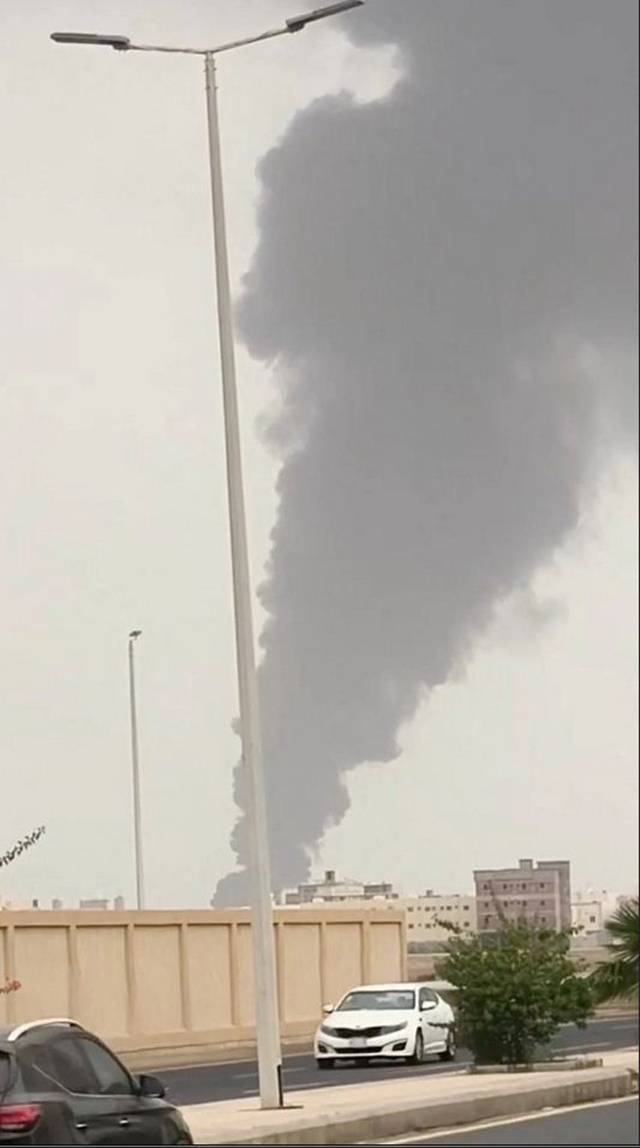
RIYADH/DUBAI/WASHINGTON – Saudi Arabia has launched a fresh wave of strikes against the Houthis in Yemen after the Iranian-backed rebels targeted Saudi energy infrastructure, in a move that risks expanding the war in the Middle East.
The Coalition to Restore Legitimacy in Yemen said Saturday it had carried out a proportionate military response against legitimate Houthi militia’s military targets in Hodeidah Governorate following the militia’s attack on commercial vessels in the Red Sea.
Coalition spokesman Maj Gen. Turki Al-Maliki said the Houthis had committed a reckless and cowardly act by targeting commercial shipping, describing the attack as part of a pattern of threats against one of the world’s most important international sea lanes.
He said the operation targeted only military sites used by the Houthis to threaten commercial vessels and stressed that the planned operational objectives had been achieved in accordance with customary international humanitarian law.
Al-Maliki said Hodeidah Port was not targeted and that Yemeni ports, including Hodeidah, Ras Isa and Salif, remain open and operational to receive commercial vessels carrying food, commodities, oil and construction materials. He added that air traffic to and from Yemeni airports also remains operational.
He accused the Houthis of continuing to prevent flights from operating at Sana’a International Airport, saying the group was imposing a siege on the Yemeni people and worsening humanitarian suffering.
The spokesman reaffirmed Saudi Arabia’s support for the Yemeni people and the country’s legitimate government, saying the Kingdom would continue standing alongside Yemen in confronting the Houthi militia. He said the Coalition would continue taking all necessary operational measures to protect the Kingdom’s interests, national assets and commercial vessels, warning that any further Houthi hostilities would be met with a firm and resolute response.
The Houthis claimed to have attacked Saudi state oil company Aramco’s facilities in Jizan and Yanbu on the Red Sea coast on Saturday, using ballistic missiles and drones. “We will not hesitate to expand our movements and escalate our steps based on the developments of the situation in the coming hours and days,” Yahya Sare’e, a Houthi spokesperson, said in a statement. The Saudi-led coalition in Yemen had earlier struck Houthi targets in the Houdedia region, acknowledging that it had carried out air strikes for the first time since the warring parties agreed to a truce four years ago. Hours after those strikes, Saudi civil defence forces warned that Jizan, which hosts a large refinery, and Yanbu, which is home to a key export terminal, were under threat, urging the public to seek shelter. Greek security officials said that air-defence systems in Saudi Arabia intercepted two ballistic missiles launched from Yemen towards Yanbu on Saturday, while a Greek-operated, US-made Patriot missile battery shot down a drone from Yemen. Greece has deployed a Patriot air-defence battery in Saudi Arabia since 2021 under a bilateral agreement to help protect the kingdom’s critical energy infrastructure. After the Houthis’ strikes, government-controlled Yemen TV reported that the Saudi-led coalition had retaliated by hitting Houthi sites in the provinces of Maarib and al-Jouf. The escalation risks edging Yemen towards the resumption of a decade-old war and expanding the conflict in the Middle East as the US and Iran battle over the Strait of Hormuz. The flare-up between the Houthis and Saudi Arabia escalated this week after the rebels warned that they were imposing a maritime blockade on the kingdom and attacked two Saudi tankers in the Red Sea. The Red Sea has become vital for Saudi exports and trade after Iran closed the Strait of Hormuz during its war with the US and Israel.
Iran reported no strikes overnight into Saturday, an apparent break from nearly two consecutive weeks of US nighttime attacks, but tensions remain high following a recent escalation over control of the strategic Strait of Hormuz and an exchange of fire reported between Saudi Arabia and the Iran-backed Houthi rebels in Yemen.
Iranian Health Ministry spokesperson Hossein Kermanpour posted on X, saying that “Iran had a peaceful night,” without any attacks reported. The US Central Command didn’t immediately respond to a request for comment. However, unlike the previous 13 nights, it did not announce new strikes.
Sirens sounded multiple times early Saturday in Saudi Arabia’s Yanbu and Jizan provinces, which house crucial oil facilities on the Red Sea, according to the Saudi Civil Defense. It said the sirens were because of a “potential danger” that was later lifted, without providing further details. Those sirens appear to have been caused by missile fire from Yemen.
Bahrain also sounded missile alerts early Saturday, but no casualties have been reported.
A tenuous ceasefire that appeared to halt major operations in the conflict that started with American and Israeli attacks on Iran seemed to unravel in early July. Iran was accused of striking three ships in the strait. The US responded by striking dozens of targets in Iran, which retaliated by firing at Arab states in the region.
The Strait of Hormuz, a crucial passage for world energy supplies effectively shut down by Iranian attacks, has been at the center of the conflict. The US military fired Friday on a merchant vessel in the Gulf of Oman that was trying to breach its renewed blockade of Iran’s ports, while Iran targeted US-allied Gulf Arab countries.
And on Saturday, Iran’s Revolutionary Guards said their forces stopped four ships attempting to transit the strategic Strait of Hormuz over the past 24 hours.
“Four vessels that had intended to transit through the southern area of the Strait of Hormuz via an illegal and unsafe route were stopped over the past 24 hours after warning shots were fired by the IRGC Navy,” the Guards said in a statement quoted by state television, adding that the ships had “altered course.”
It was not immediately clear whether the halt in attacks signalled a return to diplomacy or if it was just a pause before a return to conflict.
US President Donald Trump said Friday that he had not decided whether to launch major strikes on Iran yet, as Tehran was now getting “serious” in talks with Washington.
His comments came after reports that an increasingly frustrated Trump was meeting senior advisors to discuss launching a large-scale military operation against Iran.
“No I haven’t,” Trump told journalists in the Oval Office when asked if he had made a decision. “Look, we’re talking to them right now. I think they’re getting more and more serious as the days go by, for maybe the obvious reason.”
Trump said Iran had a choice between making a deal or facing a “much higher level” of strikes, after nearly two weeks of US attacks and Iranian strikes across the region that have left a ceasefire in tatters.
“We’re locked and loaded and ready to go. But we’re talking to them, so I think while we’re talking, we’ll see what comes of it. I believe… they’re very serious. They should be,” Trump said.
US embassies in the Middle East also alerted Americans in the region on Friday that options to leave could become more limited, as Iran’s Revolutionary Guard advised residents of neighboring countries to stay away from bases with US troops.