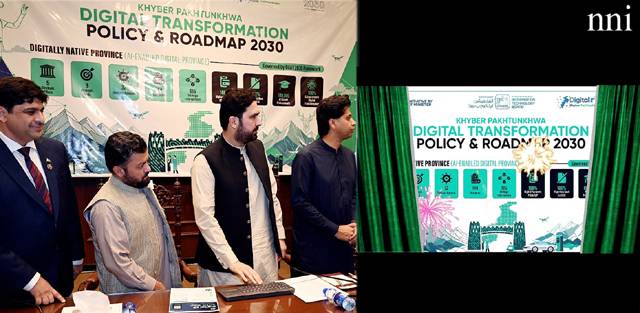
PESHAWAR – Chief Minister Muhammad Sohail Afridi on Thursday launched the Khyber Pakhtunkhwa Digital Transformation Policy and Roadmap 2030, outlining a long-term strategy to modernise public administration, expand digital public services and strengthen the province’s digital economy.
Speaking at the launch ceremony at the Chief Minister’s House, Mr Afridi said the policy would provide a comprehensive framework for promoting digital governance, improving service delivery and enhancing transparency and efficiency across government departments.
He said the provincial government remained committed to advancing digital reforms in line with its vision of a “Digital Khyber Pakhtunkhwa”, adding that technology would play a central role in improving governance, institutional performance and economic growth.
The Chief Minister praised the Khyber Pakhtunkhwa Information Technology Board (KPITB) and partner organisations for preparing the policy through a consultative process informed by international best practices.
According to the policy, the roadmap is built around five strategic pillars, nine strategic objectives, 32 thematic domains and 915 interventions, supported by phased implementation plans, clearly defined institutional responsibilities and monitoring mechanisms.
Mr Afridi said the gradual transition to paperless governance and digital public administration would improve transparency, accountability and administrative efficiency while reducing unnecessary human intervention in official processes.
He added that government services would increasingly be delivered through integrated digital platforms, enabling citizens-particularly those in remote areas-to access public services more quickly and conveniently without repeated visits to government offices.
Highlighting the importance of emerging technologies, the Chief Minister said the government was investing in artificial intelligence and advanced digital skills to prepare young people for employment, freelancing, entrepreneurship and innovation in the digital economy.
He also said the policy would promote environmentally sustainable digital infrastructure, reduce paper consumption and operational costs, and support green information and communications technology initiatives, including the establishment of a Carbon Credit Registry.
Referring to broader governance reforms, Mr Afridi said the provincial government had collected Rs150 billion in provincial revenue during the previous financial year against a target of Rs129 billion, without imposing new taxes. He said the government had set a revenue target of Rs180 billion for the current financial year and expressed confidence that collections could reach Rs200 billion.
Officials briefing the ceremony said the Digital KP 2030 initiative envisaged the progressive digitisation of government services, financial transactions and administrative systems, while more than 100,000 young people would receive training in artificial intelligence and advanced digital skills.
In keeping with the policy’s digital-first approach, the government also replaced the conventional printed policy document with a QR code, allowing stakeholders to access the document electronically.