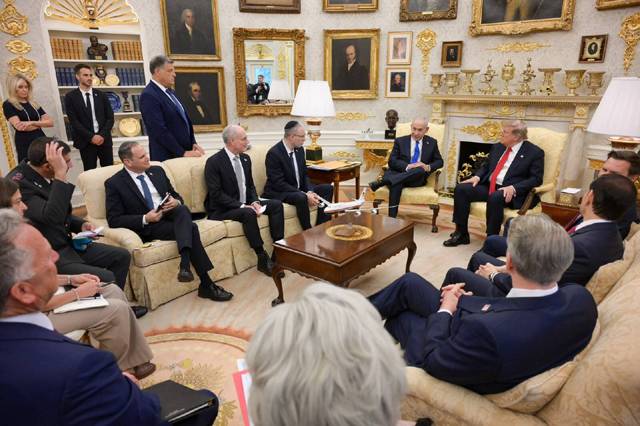
WASHINGTON – US President Donald Trump and Israeli Prime Minister Benjamin Netanyahu met in the Oval Office Tuesday for a “productive” 90-minute session on the Iran war — free of any public sign of tensions that have marked their relationship over the past several weeks.
The meeting could have gone the other way, given Trump’s frustration with the Israeli leader over the war, which he even alluded to publicly shortly before Netanyah arrived at the White House. The fact that both sides described it as positive is a win for Bibi.
An account provided by the Israeli government stressed that the two leaders are in close coordination on the war and that there is no daylight between them.
“There is no truth in the claim that Israel is pushing the US in a certain direction on the Iran issue,” Netanyahu’s communication director, Tzipi Hotovely, told reporters. “The Prime Minister is not telling the US President what to do and is not pushing him in any direction. Both sides want to prevent Iran from having nuclear weapons. There are many ways to achieve this goal.”
Netanyahu wrapped up his meeting with US President Donald Trump after nearly an hour and a half, the White House announced. Netanyahu was seen exiting the White House at 12:25 p.m. local time.
White House press secretary Karoline Leavitt said Trump’s meetings with both Netanyahu and Ukrainian President Volodymyr Zelensky were “positive and productive!”
No other information has been immediately provided about the meeting.
“We are in a critical period,” a senior Israeli official tells Channel 12 after the Oval Office meeting between Netanyahu and US President Donald Trump and their teams.
“President Trump will make a decision soon where he is heading,” says the official. “We are not pushing him, but also aren’t burying our heads in the sand. Netanyahu presented [Trump with] the Israeli perspective.”
Netanyahu presented Trump with Israeli intelligence on Iran, says the senior official.
“Netanyahu believes there is no choice” but to attack Iran again, the Channel 12 report continues, apparently still quoting the senior Israel official. These need to be “significant attacks — on nuclear facilities, capabilities that have been rebuilt, and sites that weren’t previously hit.” Such strikes, Israel believes, would have the potential to “shake the stability of the regime.”’Netanyahu held a “very good and very positive meeting” with US President Donald Trump, a senior official in the prime minister’s entourage tells The Times of Israel.
“The two talked about all arenas — primarily Iran — and reiterated the joint commitment to prevent Iran from having nuclear weapons,” says the official.
Yemen’s Houthis claim to have fired ballistic missiles at a Saudi oil tanker, accusing the vessel of violating what they describe as their maritime blockade on Saudi Arabia in the Red Sea and ignoring warning calls.
The Iran-aligned group’s military spokesperson, Yahya Saree, claims the vessel was forced to turn back.
Meanwhile, six sources with knowledge of the matter say that China has held direct talks with the Houthis to enable its tankers to sail through the southern Red Sea without being attacked.
The Houthis declared their blockade on July 20, opening a new front against the US and its allies in the Iran war and expanding attacks on tankers carrying energy and other supplies to markets beyond the Middle East.
Beijing has asked the Houthis directly to promise safe passage for its tankers, according to the sources, who include a senior Iranian official.
Iran says recent US strikes destroyed an airport and a marine control tower, and caused damage to 12 bridges and two tunnels, among other infrastructure.
Iranian government spokesperson Fatemeh Mohajerani provides the details in an announcement carried by the state-run IRNA news agency.
The US military said it struck numerous military targets this month in response to Iranian attacks on ships in the Strait of Hormuz. Iran retaliated with missile and drone attacks on Arab countries hosting US forces. Both sides paused their attacks over the weekend, though tensions remain high.
Mohajerani says Bushehr International Airport, on the Persian Gulf, has been “rendered inoperable.” Both tunnels have been reopened and alternate routes have been established around the damaged bridges, she says.
She says other civilian infrastructure had also been destroyed, including a meteorological center and fishing boats. The US says it targeted small boats used by Iranian forces to harass ships in the strait.